Weltkarte 1587
Abraham Ortelius
€ 5.500
Inter-Antiquariaat Mefferdt & De Jonge
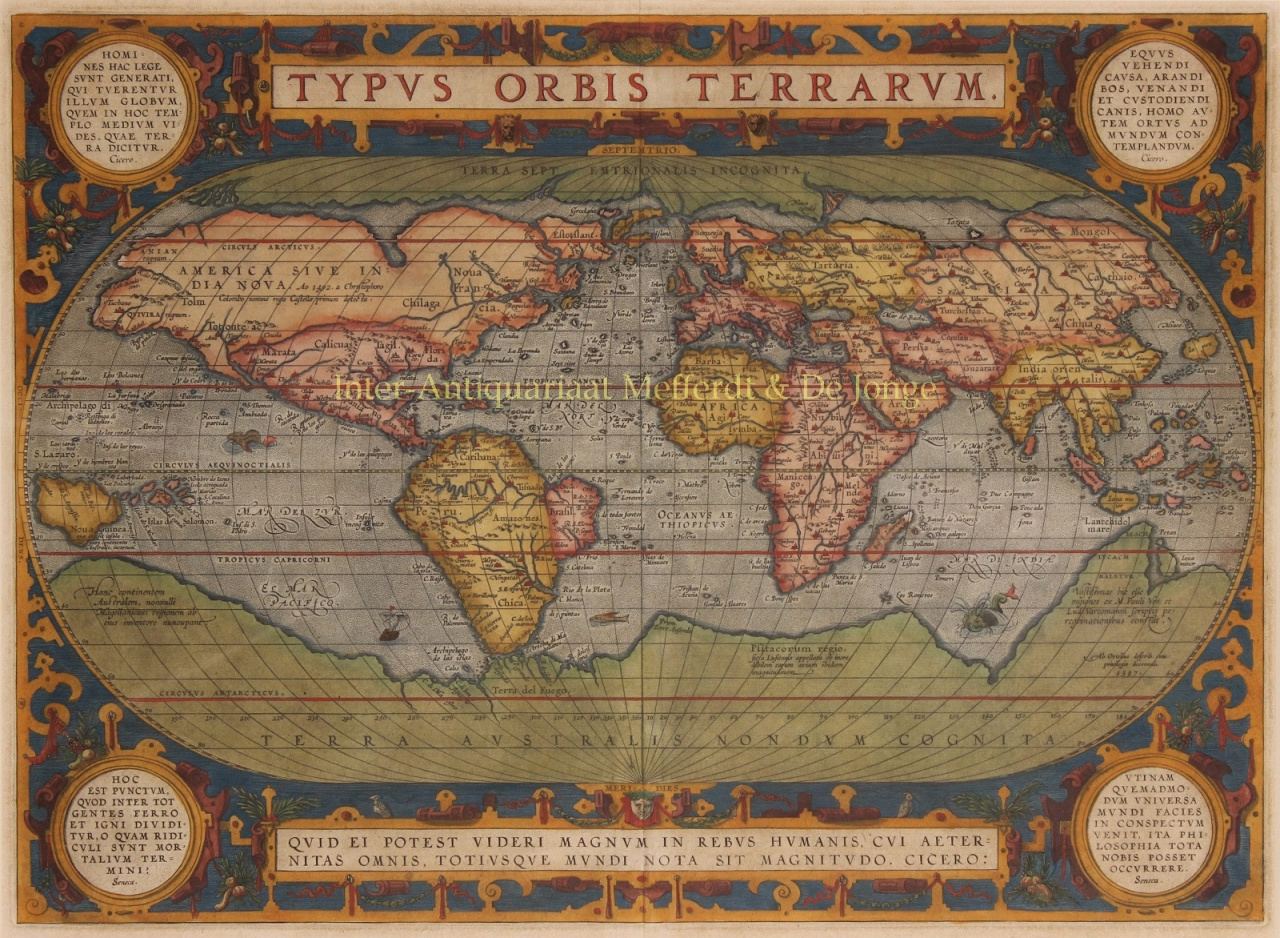
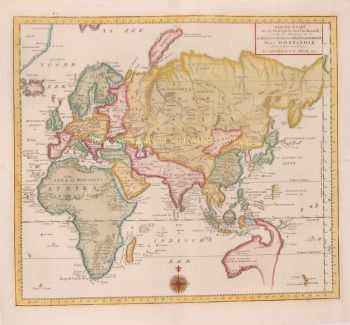
- Über KunstwerkONE OF THE GREAT WORLD MAPS OF ALL TIME "Typus Orbis Terrarum." Copper engraving from Theatrum Orbis Terrarum. Published by Arbraham Ortelius of Antwerp from 1587 onwards. With original (?) hand colouring. Size: 35,5 x 48,5 cm. One of the most famous of world maps, from Ortelius' great work, Theatrum Orbis Terrarum. Initially published in 1570, this volume was the first that could truly be called an ‘atlas’ in the modern sense of a compilation of maps engraved to a uniform format according to the most up-to-date information available. The publication of the Theatrum also marked the inauguration of the era of Dutch supremacy in cartography. For these and other reasons, Abraham Ortelius is called the "father of modern cartography." This particular map is based upon Gerard Mercator's large world map of 1569. Ortelius' atlas project had the blessing and aid of Mercator, who supplied Ortelius with coordinates of places in America. Although the map appears rather erroneous to modern eyes, it actually contains some of the best compilation work of the period, which was a hallmark of mapmaking in the sixteenth century. In the north, islands are shown surrounding the North Pole, and separated from America and Asia by a sea passage, the latter being a popular belief in the sixteenth century. In the south, a large "Terra Australis Nondum Cognita" is drawn, separated from South America by the "Estrecho di Magallanes." “From surviving correspondence it is known that Mercator generously encouraged Ortelius to make use of his published corpus of research; he also provided him with coordinates of places in America and perhaps elsewhere.” – Shirley In 1587 Ortelius updated this seminal map for the third and last time. South America now assumes a more accurate shape, and the Solomon Isles are marked for the first time. The updated map is also distinctive and especially beautiful for the four medallions in the corners with classical texts, two from Cicero and two from Seneca. The border of this map is altered as well, now with a more intricate and elegant lattice of strapwork and swag. Altogether with the embellishments, rich colour and important information, one of the great world maps of all time. Literature: “Ortelius atlas maps”, Marcel van den Broecke, Ort3; “The Mapping of the World”, Rodney Shirley, no. 158, plate 130. Price: Euro 5.500,- (incl. frame)
- Über Künstler
Abraham Ortelius (1527–1598) war ein flämischer Kartograf und Geograph, der weithin als Schöpfer des ersten modernen Atlas und einer der einflussreichsten Kartografen der Geschichte gilt. Seine bahnbrechende Publikation „Theatrum Orbis Terrarum“ (Theater der Welt) markierte einen Wendepunkt in der Art und Weise, wie geographisches Wissen gesammelt, standardisiert und präsentiert wurde.
Das 1570 erstmals erschienene „Theatrum Orbis Terrarum“ war sowohl konzeptionell als auch in seiner Ausführung revolutionär. Anders als frühere Kartensammlungen bot Ortelius’ Atlas einen kohärenten und systematischen Überblick über die bekannte Welt mit Karten einheitlicher Größe, einheitlichem Stil und einheitlicher Qualität, begleitet von wissenschaftlichen Kommentaren. Dieser Ansatz wandelte die Kartographie von einem fragmentierten Handwerk in eine strukturierte wissenschaftliche und kulturelle Disziplin und machte die globale Geographie Gelehrten, Kaufleuten und Staatsmännern gleichermaßen zugänglich.
Ortelius lebte und wirkte im Goldenen Zeitalter der niederländischen Kartographie, einer Zeit, in der Fortschritte in der Erforschung, im Buchdruck und im Handel das europäische Weltverständnis grundlegend veränderten. Neben Gerardus Mercator gilt Ortelius als einer der Begründer der niederländischen Kartografieschule. Während Mercator die Kartenprojektion revolutionierte, zeichnete sich Ortelius durch seine Synthese aus – er vereinte das beste verfügbare geographische Wissen in einem einzigen, maßgeblichen Werk.
Über seine technischen Leistungen hinaus war Ortelius ein humanistischer Denker mit einem tiefen Interesse an Geschichte, der klassischen Antike und dem kulturellen Austausch. Er unterhielt ein weitreichendes internationales Netzwerk von Gelehrten, Entdeckern und Kartografen und gab seine Quellen sorgfältig an – eine für seine Zeit ungewöhnliche und fortschrittliche Praxis. Diese wissenschaftliche Integrität trug wesentlich zur Glaubwürdigkeit und zum anhaltenden Einfluss seines Werkes bei.
Abraham Ortelius’ Vermächtnis liegt nicht nur in seinen Karten, sondern auch in seiner Vision der Welt als vernetztes Ganzes. Sein Atlas prägte die europäische Weltsicht über Generationen hinweg und legte den Grundstein für die moderne Kartografie, wodurch er sich einen Platz unter den großen Geistesgrößen der Renaissance sicherte.

Sind Sie daran interessiert, dieses Kunstwerk zu kaufen?
Artwork details
Related artworks
- 1 - 4 / 6
- 1 - 4 / 24
- 1 - 4 / 12