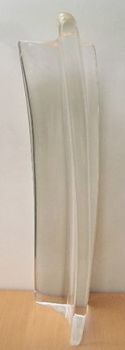
ynthetic Construction F6 1960 - 1980
Joost Baljeu
PlexiglasFotodruck
55 ⨯ 16 ⨯ 16 cm
ConditionExcellent
€ 4.950 - 6.950
The Millen House
- Über KunstwerkJoost Baljeu geometric plexiglass sculpture — “Synthetic Construction F6,” design 1967, produced as Multiple Series I in 1975, a rare editioned constructivist work (no. 11/25).
This refined geometric sculpture (55 × 16 × 16 cm) is part of Joost Baljeu’s important Synthetic Constructions, a series in which he translated the principles of postwar Constructivism into spatial, modular forms using industrial materials. Synthetic Construction F6 is built from interlocking planes of translucent and opaque plexiglass, creating shifting light effects and a dynamic vertical rhythm. The work exemplifies Baljeu’s exploration of colourless architecture in space, where the sculpture’s form changes subtly as the viewer moves around it. Produced in 1975 as part of Multiple Series I, this piece is numbered 11/25 and bears the artist’s signature underneath, accompanied by the original label.
Condition is excellent, with clean surfaces and only minimal age-appropriate traces consistent with plexiglass works from the period. The structure is stable, edges remain crisp, and the base is original.
About the Artist
Joost Baljeu (1925–1991) was a key figure in Dutch Constructivism and a central contributor to postwar geometric abstraction. His work appears in major museum collections including the Stedelijk Museum Amsterdam, Kröller-Müller Museum, and international institutions focused on constructivist and concrete art.
A rare, editioned Baljeu multiple — an essential object for collectors of postwar geometric abstraction. - Über Künstler
Joost Baljeu (Middelburg, 1. November 1925 – Amsterdam, 1. Juli 1991) war ein bedeutender niederländischer Künstler, bekannt für seine konstruktivistischen Skulpturen und geometrisch-abstrakten Gemälde. Baljeu gehörte zur internationalen Bewegung, die, inspiriert von De Stijl und den Idealen der Moderne, eine Synthese von Kunst und Architektur anstrebte. Sein Werk erforscht Raumkonstruktion, Farbe und Form mit einem Schwerpunkt auf modularen Strukturen, die die Grenze zwischen Kunstobjekt und Architekturelement auflösen.
Ab den 1950er Jahren entwickelte Baljeu seine ikonischen Raumkonstruktionen aus Stahl und farbigen Paneelen, in denen er eine visuelle Spannung zwischen offenen und geschlossenen Volumen erzeugte. Seine Kunst zeichnet sich durch rhythmische Linien, strenge Geometrien und leuchtende Farbkontraste aus und lädt den Betrachter ein, das Bild dynamisch im Raum zu erleben.
Baljeu war international als Künstler, Autor und Dozent tätig. Er war Professor an der Rijksakademie in Amsterdam und veröffentlichte einflussreiche kunsthistorische und -theoretische Texte zum Konstruktivismus und zu De Stijl. Seine Werke befinden sich in bedeutenden Museumssammlungen, darunter das Stedelijk Museum Amsterdam, das Kunstmuseum Den Haag, das Kröller-Müller Museum und diverse internationale Kunstinstitutionen. Große Skulpturen von Baljeu sind auch heute noch im öffentlichen Raum in den Niederlanden und im Ausland zu sehen.
Mit seinem bahnbrechenden Ansatz zur abstrakten Kunst und seiner Vision von Kunst im gebauten Raum hat Joost Baljeu Generationen von Künstlern und Designern nachhaltig geprägt. Sein Œuvre gilt als wichtiger Bezugspunkt in der Geschichte des internationalen Konstruktivismus und der niederländischen Moderne.

Sind Sie daran interessiert, dieses Kunstwerk zu kaufen?
Artwork details
Related artworks
- 1 - 1 / 1
- 1 - 4 / 24
- 1 - 4 / 24
Jean-François Rauzier
Mosquée Rustem Pacha - Limited edition of 8 2015
Preis auf AnfrageVilla del Arte Galleries
1 - 4 / 24- 1 - 4 / 12