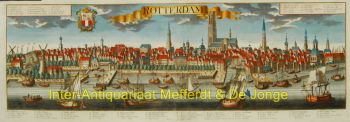
FIRST PRINTED VIEW OF MUNICH “Monacum” [Munich], woodcut from a Latin edition of the famous "Liber chronicarum" by Hartmann Schedel, printed by Anton Koberger in 1493. With original (?) hand colouring. Size: (view) 20.0 x 51.3 cm (sheet: 46.0 x 61.5 cm). At the end of the 15th century, Munich was an emerging center of political and economic power within the Holy Roman Empire: “Munich, a city in Germania Superior situated on the banks of the River Isar. Among the principal cities in Germany, it is the most renowned in Bavaria and very noble. Although considered among the newer cities, it surpasses other cities in both public and private buildings. It has very beautiful buildings, wide streets, and very ornate basilicas.” The city had grown significantly since its founding in 1158 by Henry the Lion, Duke of Bavaria. By the late 1400s, Munich had established itself as the ducal residence of the Wittelsbach family, who played a crucial role in its development and fortification. Munich as we see it here in bird's-eye perspective, was characterized by medieval architecture, including fortified walls, gates, and defensive towers, indicative of its strategic importance. The city was compact and densely built and had a central market square that served as the hub of civic life, the Marienplatz. Prominent structures include the Altes Rathaus (Old Town Hall), constructed in the early 15th century, Peterskirche (St. Peter’s Church), here still with the Gothic double towers and the Frauenkirche (Cathedral of Our Lady), whose construction began in 1468 and was completed in 1488. The Frauenkirche, with its distinctive twin towers, became a landmark of the city. Hartmann Schedel’s Liber Chronicarum: Das Buch der Croniken und Geschichten [book of chronicles and stories], popularly referred to as the Nuremberg Chronicle (from the city of its publication), was the first secular book to include the style of lavish illustrations previously reserved for Bibles and other liturgical works. The project to produce the Nuremberg Chronicle was instigated by the artist Michael Wolgemut (1434/37–1519), who with Wilhelm Pleydenwurff (c. 1450-94), conceived and executed its illustrations and engravings (one of Wolgemut’s apprentices included the young Albrecht Dürer but it is no longer thought that he worked on the Chronicle). To finance this expensive and hugely risky undertaking Wolgemut obtained the support of two wealthy patrons, Sebald Schreyer (1446-1520) and his brother-in-law Sebastian Kammermaister (1446-1520), after which the famous Nuremberg printer Anton Koberger (ca.1440-1513), agreed to do the printing. The task of actually writing the work was assigned to the Nuremberg physician and humanist Hartmann Schedel (1440-1514). The diverse range of medieval and Renaissance sources used were drawn from authors Schedel studied as a student (at Leipzig and Padua), including Bede, Vincent of Beauvais, Martin of Tropau, Flavius Blondus, Bartolomeo Platina and Philippus de Bergamo. Like most incunabula (i.e. books printed before 1501), the work was published in Latin, although a German version was also produced a few months later. The work was intended as a history of the world, from beginning of time to the 1490s, with a final section devoted to the anticipated Last Days of the World. It is without question the most important illustrated secular work of the 15th Century and its importance rivals the early printed editions of Claudius Ptolemy’s Geographia and Bernard von Breydenbach’s Peregrinatio in Terram Sanctam in terms of its importance in the development and dissemination of illustrated books in the 15th Century. While the majority of the illustrations in the book depict the various saints, royalty, nobles and clergyman of the period, the work is perhaps best known for the large format views of a number of the major European Cities, including Rome, Venice, Paris, Vienna, Florence, Genoa, Salzburg, Cracow, Breslau, Budapest, Prague, and major cities in the Middle East, including Jerusalem, Alexandria, Constantinople, as well as a number of cities in what would become the German Empire. While many of the double-page city views are less than accurate illustrations of the cities as they existed at the end of the 15th Century, they are of great importance in the iconographic history of each of the cities depicted. Price: Euro 1.650,- (incl. frame)








![[copy] De blauwe hoek by Jasper van Deutekom](https://media-2.gallerease.com/images/b9d84335-95d4-46c2-8cd7-89b9bacefc2f/350x350/copy-de-blauwe-hoek.jpg)