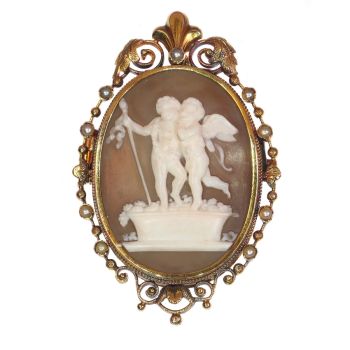
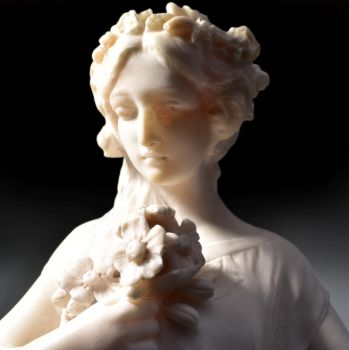
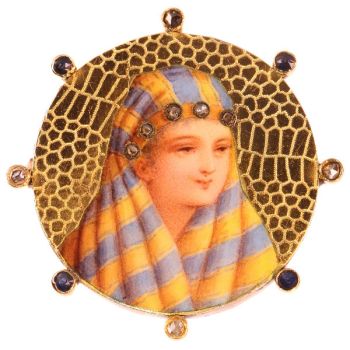
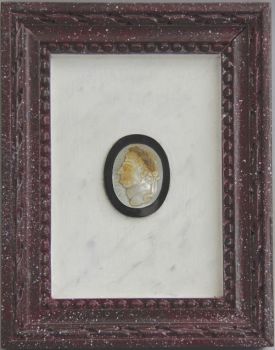
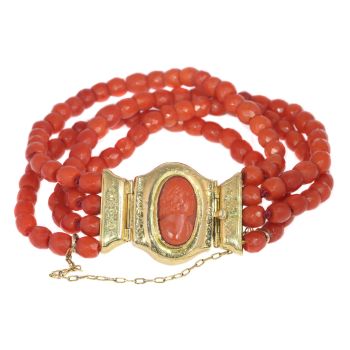
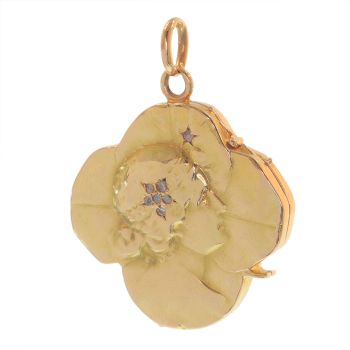
This late Victorian to early Art Nouveau brooch shows an ivory cameo of unusually fine quality. The low relief is carved with crisp definition, yet carries the gentle, dreamy mood so typical of early twentieth-century portrait work. Set in warm gold and signed “A. v. Dongen”, it offers the quiet pleasure of studying craftsmanship where every delicate curve rewards a closer look.
Jewellery Type
brooch
Condition
very good condition
more info on our condition scale
Country of origin
unknown
Style
Between Victorian and Art Nouveau - Victorian decorative arts refers to the style of decorative arts during the Victorian era. The Victorian era is known for its eclectic revival and interpretation of historic styles and the introduction ofcross-cultural influences from the middle east and Asia in furniture, fittings, and Interior decoration. Victorian design is widely viewed as having indulged in a regrettable excess of ornament.
The Arts and Crafts movement, the aesthetic movement, Anglo-Japanese style, and Art Nouveau style have their beginnings in the late Victorian era. Art Nouveau (French for New Style) is an international movement and style of art, architecture and applied ar - especially the decorative arts - that peaked in popularity at the turn of the 20th century (1890–1905).
The name "Art Nouveau" is French for "new art". It is also known as “Jugendstil”, German for "youth style", named after the magazine Jugend, which promoted it, and in Italy, Stile Liberty from the department store in London, Liberty & Co., whichpopularised the style. A reaction to academic art of the 19th century, it is characterized by organic, especially floral and other plant-inspired motifs, as well as highly stylized, flowing curvilinear forms.
Art Nouveau is an approach to design according to which artists should work on everything from architecture to furniture, making art part of everyday life.
See also: late-Victorian, early Art Nouveau, eclecticism
more info on styles
Style specifics
Late Victorian / early Art Nouveau - The subject of this piece, although typical 19th Century, announces the coming of the Art Nouveau style.
Period
ca. 1900
Events & facts of this era, poetry of this era, fashion of this era.
Theme
young child's face
Material 14K
yellow gold (touchstone tested)
more info on precious metals
Important note
This piece contains antique ivory and can therefore only be shipped within the European Community under current regulations.
Technique
Cameo is a method of carving, or an item of jewellery or vessel made in this manner. It features a raised (positive) relief image. There are three main materials for Cameo carving; Shells or Agate (called a Hardstone cameo), and glass. Cameos can beproduced by setting a carved relief, such as a portrait, onto a background of a contrasting colour. This is called an assembled cameo. Alternately, a cameo can be carved directly out of a material with integral layers or banding, such as (banded) agateor layered glass, where different layers have different colours. Sometimes dyes are used to enhance these colours. Cameos are often worn as jewellery. Stone cameos of great artistry were made in Greece dating back as far as the 6th century BC. They werevery popular in Ancient Rome, and one of the most famous stone cameos from this period is the Gemma Claudia made for the Emperor Claudius. The technique has since enjoyed periodic revivals, notably in the early Renaissance, and again in the 17th, 18thand 19th centuries.
Extra information
The child’s features show no correspondence with any documented child portraits from Western royal families of the late nineteenth and early twentieth centuries, and no match was found in the known imagery from that period. The signature “A. v. Dongen”is not associated with royal commissions, and there is no archival link to any court artist. Portrait cameos of children were common personal keepsakes among affluent families, making it most likely a privately commissioned portrait of a non-royal child.
Signature
"A. v. Dongen" an otherwise unidentified artist with a Dutch surname.
Hallmarks
No trace.
more info on hallmarks
Dimensions
as pendant 5,60 cm (2,20 inch) x 4,20 cm (1,65 inch), as brooch 4,85 x 4,20 cm (1,65 inch)
see picture with a ruler in millimeters and inches
Weight
17,40 gram (11,19 dwt)
Adin Reference Nº
25321-0183
Copyright photography
Adin, fine antique jewellery
Additional information
our latest acquisitions
jewelry glossary
wall of fame
visit us in Antwerp
subscribe to our mailinglist