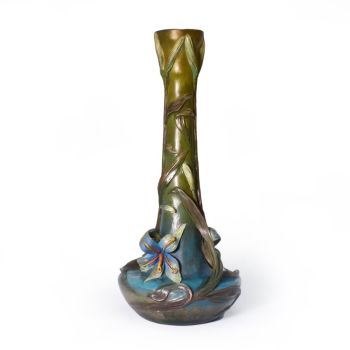
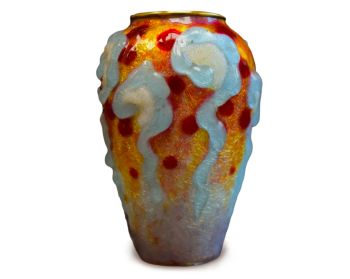
Daum Nancy – Tall Bryones / Bryonia dioica vase with applied berries 1902 - 1907
Daum Nancy
Glas
54 cm, ø 18 cm
ConditionNear mint
Preis auf Anfrage
Antiques Emporium
- Über KunstwerkThis impressive Daum Nancy Bryones vase, crafted in the early years of the 20th century, stands at an extraordinary height of 54.5 cm and showcases the detailed beauty of the plant Bryonia dioica, also known as Bryony. This plant, commonly referred to as red bryony, is a climbing plant from the cucumber family, recognized for its deeply lobed leaves and striking red berries. Bryonia dioica is often found as a native climber in Europe and is a characteristic feature of rural landscapes.
The design for this vase was created by Henri Bergé, a talented designer who played a prominent role in the Art Nouveau movement from the late 19th century, particularly through his work for Daum Nancy. Bergé, renowned for his botanical precision and artistic interpretations of nature, developed iconic designs that placed plants and flowers at the forefront. His creations were both technically advanced and aesthetically groundbreaking, making him an influential figure in the world of glass and decorative arts.
The design drawing for this décor, made in pen and watercolor, is preserved in the archives of the Musée des Beaux-Arts in Nancy and is signed by Henri Bergé. This sketch highlights the meticulous and detailed approach Bergé took to his designs, capturing the expressive qualities of Bryonia dioica in a sublime manner.
The vase itself is adorned with applied red glass ornaments representing the berries of the bryony, creating a striking and colorful contrast with the subtle green of the leaves. These decorative details highlight the delicate balance between form and color that characterizes Daum’s glass artistry from this period, enhancing the natural appearance of the piece. This vase, with its botanical decoration and impressive size, is a refined example of the collaboration between craftsmanship and artistic vision within the Art Nouveau movement. - Über Künstler
Daum Nancy zählt zu den einflussreichsten und raffiniertesten Glasmanufakturen der europäischen Kunstgeschichte. Die Marke wurde 1878 in Nancy von Jean Daum gegründet, einem ehemaligen Notar, der das Potenzial der aufkommenden Glaskunst im Elsass-Lothringen erkannte. Was als bescheidene Glasmanufaktur begann, entwickelte sich unter der Leitung seiner Söhne Auguste und Antonin Daum zum pulsierenden Zentrum des französischen Jugendstils.
Im Gegensatz zur industriellen Massenproduktion verfolgte Daum Nancy stets einen fast poetischen Ansatz im Umgang mit Glas. Die Brüder experimentierten obsessiv mit Texturen, Farbverläufen und dem Spiel des Lichts durch die verschiedenen Glasschichten. Berühmt wurden sie für ihr mehrschichtiges Kameenglas, in dem florale Motive, Libellen, Landschaften und die Jahreszeiten aus dem Glas zu wachsen scheinen. Jedes Stück ist kein bloßes Objekt, sondern eine Skulptur: organisch, traumhaft und tief mit der Natur verwoben.
Daum arbeitete intensiv mit Künstlern der École de Nancy zusammen, darunter Émile Gallé, Henri Bergé und Jacques Grüber. Diese Verschmelzung von Handwerk und Kunst führte zu einer revolutionären neuen Glaskunst: sinnlich, technisch fortschrittlich und von unglaublicher Zartheit. Um 1900 gewann Daum internationale Auszeichnungen und avancierte zu einer der begehrtesten Marken im Bereich Luxus und dekorative Kunst.
Bis heute ist Daum Nancy seinen Ursprüngen treu geblieben: Kristallglas wird vollständig in Handarbeit gefertigt, oft unter Verwendung der gleichen Pâte-de-Verre-Technik, die die Manufaktur Anfang des 20. Jahrhunderts wiederentdeckte. Die Marke steht für französische Eleganz, Handwerkskunst und eine seltene Kontinuität künstlerischer Identität.
Sind Sie daran interessiert, dieses Kunstwerk zu kaufen?
Artwork details
Related artworks
- 1 - 3 / 3
- 1 - 4 / 24
Johann Loetz (Lötz) Witwe Klostermühle
Johann Loetz Witwe – Phänomen Genre 299 – Tricolor vase1900 - 1902
Preis auf AnfrageAntiques Emporium
Johann Loetz (Lötz) Witwe Klostermühle
Johann Loetz Witwe – Phänomen Genre 1/18 vase1901 - 1905
Preis auf AnfrageAntiques Emporium
Johann Loetz (Lötz) Witwe Klostermühle
Johann Loetz Witwe - Phänomen Genre 7773 – Orange1900 - 1910
Preis auf AnfrageAntiques Emporium
1 - 4 / 24- 1 - 4 / 24
Johann Loetz (Lötz) Witwe Klostermühle
Johann Loetz Witwe – Phänomen Genre 377- silver overlay1900 - 1902
Preis auf AnfrageAntiques Emporium
1 - 4 / 24Johann Loetz (Lötz) Witwe Klostermühle
Johann Loetz Witwe - Phänomen Genre 7773 – Orange1900 - 1910
Preis auf AnfrageAntiques Emporium
Johann Loetz (Lötz) Witwe Klostermühle
Johann Loetz Witwe – Phänomen Genre 8065 – Thea1899 - 1900
Preis auf AnfrageAntiques Emporium
Johann Loetz (Lötz) Witwe Klostermühle
Johann Loetz Witwe – Phänomen Genre 299 – Tricolor vase1900 - 1902
Preis auf AnfrageAntiques Emporium
Johann Loetz (Lötz) Witwe Klostermühle
Johann Loetz Witwe – Phänomen Genre 377- silver overlay1900 - 1902
Preis auf AnfrageAntiques Emporium
Frères Foundry Susse
Auguste Ledru – Gilded Bronze Art Nouveau Ewer-Vase – Susse Frères, Paris1898 - 1902
Preis auf AnfrageAntiques Emporium
Johann Loetz (Lötz) Witwe Klostermühle
Johann Loetz Witwe – Phänomen Genre 1/18 vase1901 - 1905
Preis auf AnfrageAntiques Emporium
1 - 4 / 12