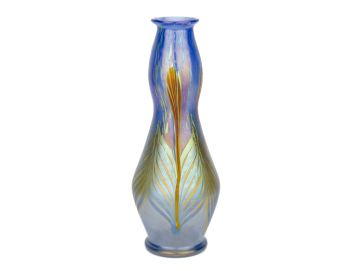
Johann Loetz Witwe – Phänomen Genre 299 – Tricolor vase 1900 - 1902
Johann Loetz (Lötz) Witwe Klostermühle
GlasZinnGoldMetall
29 cm, ø 9 cm
ConditionVery good
Preis auf Anfrage
Antiques Emporium
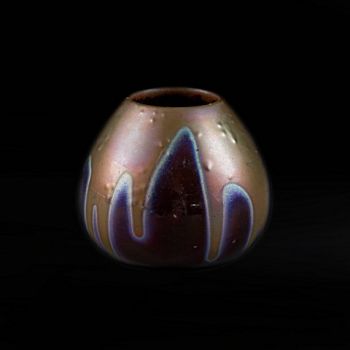
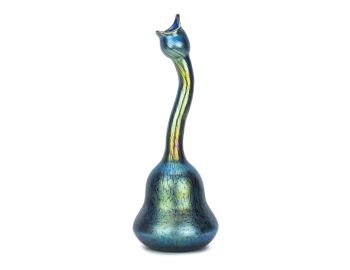
- Über KunstwerkThis Johann Loetz Witwe vase, executed in the exceptional Phänomen Genre 299, known as Tricolor, masterfully embodies the splendor and artistic ingenuity of Jugendstil glass. Standing 29 cm tall, this vase is a refined and rare piece that, due to its color composition and craftsmanship, represents a highly coveted collector’s item. The exquisite Tricolor decoration, introduced around 1900 shortly after the Paris World Exhibition, features broad vertical stripes in rich blue, intense red, and vibrant yellow—a color palette that captivates with its depth and iridescent sheen.
The delicate color pattern is accentuated by a subtle, oil-like sheen that seems to dance across the glass surface, adding an extra dimension and giving the vase a dynamic appearance. This visual richness is further enhanced by the gilded Jugendstil-style mount, crafted by the renowned German firm Bitter & Gobbers, which seamlessly integrates with the glasswork, lending the vase a noble elegance.
The Tricolor technique exemplifies the technical mastery of the Loetz workshop and their ability to create timeless glassworks. This piece symbolizes the innovative aesthetics of Art Nouveau, celebrating iridescent color transitions and natural forms. This Loetz vase is not merely an art object but also a testament to a style period that continues to be admired worldwide for its refined craftsmanship and enduring beauty.
Condition: The vase is in very good condition. The glass is flawless, and the gilding shows minimal wear. The mount has a small fracture. - Über Künstler
Etwas mehr als hundert Jahre existierte die Glashütte Lötz in Klostermühle, Österreich, ab 1840. Ihre Blütezeit erlebte sie jedoch zu Lebzeiten von Max Ritter von Spaun, dem Enkel des ursprünglichen Gründers Johann Lötz.
Von Spaun übernahm 1879 das Unternehmen und führte es bis 1908, ein Jahr vor seinem Tod. Er wurde von seinem technischen Spezialisten Eduard Prochaska unterstützt, und gemeinsam erfanden, entwarfen und produzierten sie eine ganze Reihe wunderbarer neuer Glasarten, erwarben mehrere Patente und gewannen Preise auf allen großen Weltausstellungen in den 1890er Jahren und in den ersten Jahren des 19. das neue Jahrhundert.
Die Firma Loetz gehörte zu den Vorreitern im Jugendstildesign und insbesondere im Bereich des schillernden Kunstglases. "Papillon"-Glas, wie die Vase links, wird heute manchmal als "Ölfleck"-Glas bezeichnet. Eine weitere beliebte Farbe von Loetz war bestrahltes Glas mit gezogenen Spuren, das als "Phenomenon" -Glas bezeichnet wird.
Es gab irritierte Vasen mit Bändern in Metallic-Farben, die sich über die Oberfläche schlängelten, und viele spektakuläre Designs mit applizierten Pfaden in schönen Farben oder einfach aus dem Glaskörper herausgezogen, um Griffe oder Dekorationen zu bilden.
Um 1900 begann das Unternehmen mit externen Designern zusammenzuarbeiten, und einige große Künstler entwarfen Stücke für Lotz, insbesondere Joseph Hofmann, Koloman Moser, Maria Kirchner und Hofstatter.
1908 wurde Loetz von Max von Spauns Sohn, auch Max genannt, übernommen, und obwohl es finanziell zu kämpfen hatte (Konkurs 1911 und erneut 1931), gab es mehrere große Designer, deren Arbeiten in diesen Jahren und durch die Kunst von Loetz produziert wurden Deko-Zeit. Dazu gehörten Adolf Beckert und Michael Powolny.
Sind Sie daran interessiert, dieses Kunstwerk zu kaufen?
Artwork details
Related artworks
Johann Loetz (Lötz) Witwe Klostermühle
Johann Loetz Witwe - Phänomen Genre 7773 – Orange1900 - 1910
Preis auf AnfrageAntiques Emporium
Johann Loetz (Lötz) Witwe Klostermühle
Johann Loetz Witwe – Phänomen Genre 8065 – Thea1899 - 1900
Preis auf AnfrageAntiques Emporium
Johann Loetz (Lötz) Witwe Klostermühle
Johann Loetz Witwe – Phänomen Genre 377- silver overlay1900 - 1902
Preis auf AnfrageAntiques Emporium
Johann Loetz (Lötz) Witwe Klostermühle
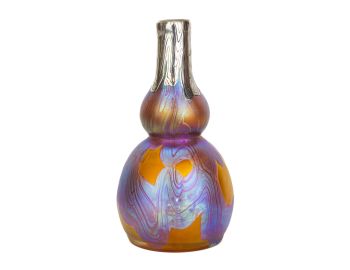
Johann Loetz Witwe – Phänomen Genre 1/18 vase1901 - 1905
Preis auf AnfrageAntiques Emporium
1 - 4 / 8- 1 - 4 / 24
Johann Loetz (Lötz) Witwe Klostermühle
Johann Loetz Witwe – Phänomen Genre 8065 – Thea1899 - 1900
Preis auf AnfrageAntiques Emporium
Johann Loetz (Lötz) Witwe Klostermühle
Johann Loetz Witwe – Phänomen Genre 377- silver overlay1900 - 1902
Preis auf AnfrageAntiques Emporium
1 - 4 / 24Jan Sluijters
Mother with two children in bathroom1900 - 1950
Preis auf AnfrageStudio 2000 Art Gallery
Frères Foundry Susse
Auguste Ledru – Gilded Bronze Art Nouveau Ewer-Vase – Susse Frères, Paris1898 - 1902
Preis auf AnfrageAntiques Emporium
Johann Loetz (Lötz) Witwe Klostermühle
Johann Loetz Witwe – Phänomen Genre 377- silver overlay1900 - 1902
Preis auf AnfrageAntiques Emporium
1 - 4 / 24- 1 - 4 / 24
Unbekannter Künstler
François-Théodore Legras – Tall “Fleurs de Pommier” apple blossoms vase1900 - 1909
Preis auf AnfrageAntiques Emporium
Frères Foundry Susse
Auguste Ledru – Gilded Bronze Art Nouveau Ewer-Vase – Susse Frères, Paris1898 - 1902
Preis auf AnfrageAntiques Emporium
Johann Loetz (Lötz) Witwe Klostermühle
Johann Loetz Witwe – Phänomen Genre 377- silver overlay1900 - 1902
Preis auf AnfrageAntiques Emporium
Johann Loetz (Lötz) Witwe Klostermühle
Johann Loetz Witwe - Phänomen Genre 7773 – Orange1900 - 1910
Preis auf AnfrageAntiques Emporium
Johann Loetz (Lötz) Witwe Klostermühle
Johann Loetz Witwe – Phänomen Genre 1/18 vase1901 - 1905
Preis auf AnfrageAntiques Emporium
1 - 4 / 12