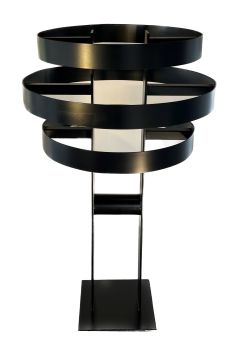
‘The Onion’ (Lök / Löken) pendant by Helge Zimdal are a series of mid-century Scandinavian pendants designed in the 1960s for Swedish maker Falkenbergs Belysning. “Löken,” Swedish for “onions,” refers to their rounded, organic silhouette that gives them a warm, sculptural presence. They were made in a few variants — most commonly in solid brass, but also in hand-blown glass and rarer copper versions — all reflecting clean, understated Scandinavian Modern styling.
Because they were produced in limited runs and are seldom encountered today, especially in the less usual materials, these pendants are considered notably rare and collectible.
About Helge Zimdal
Helge Zimdal (Alingsås, Sweden 1903 – 2001) was a Swedish lighting designer active primarily during the mid-20th century, a period marked by the international rise of Scandinavian modernism. Although he never achieved the same level of name recognition as some of his contemporaries, Zimdal’s work has come to be appreciated for its quiet clarity, strong material sensibility, and close alignment with Swedish functionalist ideals.
Zimdal worked mainly in the 1950s and 1960s, designing lighting for Swedish manufacturers such as Falkenbergs Belysning. His designs emerged in a context where lighting was increasingly understood as both a technical and architectural element of the interior. Rather than aiming for expressive or decorative excess, Zimdal focused on balanced proportions, controlled light distribution, and durable construction. His lamps were intended for everyday use, yet they possess a sculptural restraint that places them firmly within the Scandinavian modern tradition.
He is best known for ‘Löken’ pendant series, named after the Swedish word for “onions,” which refers to the softly rounded, layered form of the fixtures. These pendants exemplify Zimdal’s approach: simple geometry, carefully chosen materials, and a form that enhances the quality of light without drawing unnecessary attention to itself. Produced in limited numbers, the Löken pendants were made in materials such as brass, glass, and occasionally copper, each version emphasizing warmth and longevity rather than trend-driven finishes.
Zimdal’s design language reflects broader post-war Scandinavian values — honesty of materials, clarity of function, and an understated aesthetic suited to domestic and public interiors alike. His lamps often rely on subtle detailing rather than overt stylistic gestures, allowing them to integrate easily into a wide range of architectural settings. This discretion may partly explain why his name remained relatively low-profile during his lifetime, even as his work met high standards of craftsmanship and design integrity.
In recent years, Helge Zimdal’s work has gained increased recognition among collectors and design historians. The relative scarcity of surviving examples, combined with renewed interest in mid-century Scandinavian lighting, has brought his designs back into focus. Today, Zimdal is regarded as a representative figure of Swedish modern lighting design — not defined by prolific output or international fame, but by a consistent, thoughtful approach that continues to resonate through the enduring quality of his work.
Extra informatie
Marked
Unmarked, well known design
Condition
These vintage pendants are in very good vintage condition. Some light scratches and wear consistent of age and use. Original lamp-fitting (E27), recently rewired.
Dimensions
H. 22 cm
Diam. 22 cm