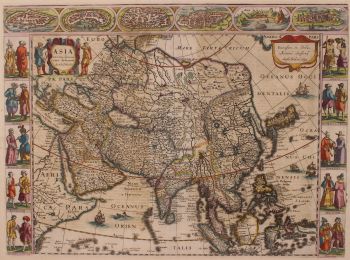
North America - Pierre Mariette + Guillaume Sanson by Unbekannter Künstler
Scroll to zoom, click for slideshow

North America - Pierre Mariette + Guillaume Sanson 1669

Unbekannter Künstler

Papier
40 ⨯ 55 cm
€ 2.750

Inter-Antiquariaat Mefferdt & De Jonge

  • Über Kunstwerk
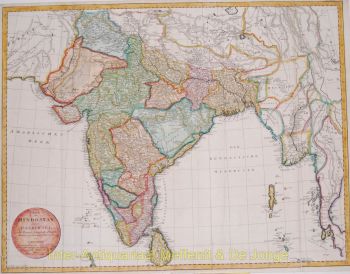
    Amerique Septentrionale Copper engraving made by Pierre Mariette and published by Guillaume Sanson in 1669 after the death of Guillaume's father, Nicolas, in 1667. Coloured by a later hand. Size: 40 x 55 cm. It is a reduced-size copy of Nicolas Sanson's four-sheet wall map of North America, published in 1666, which survives in only two known examples (one dated 1666, one dated 1667). However, this map has changed as compared to its wall-map predecessor. It includes C. Blanco in California and adds R. de Nort, or the Hudson River. The shape of Iceland and the British Isles are also new. The continent is tightly framed, with only a small part of northern South America visible. California is shown as an island, in the form originating from British explorer Luke Foxe's map published in 1635. The northwest of the continent is empty and obscured by the decorative cartouche. In the northeast, Greenland appears connected to North America. New North Wales seemingly floats in northern Hudson’s Bay, giving way to another coastline, New Denmark. This trails southwest-ward to a Mer Glaciale—the dream of a Northwest Passage is alive and well on this map. Much of this configuration is inspired by Thomas Button’s trip to Hudson’s Bay in 1612-3, when he named Port Nelson and Ne Ultra. Button’s Bay is named for him. Luke Foxe, on another voyage seeking the passage in 1631, named the area New Wales. The center of the continent is dominated by Quivira. This toponym refers to the Seven Cities of Gold sought by the Spanish explorer Francisco Vasquez de Coronado in 1541. In 1539, Coronado wandered over what today is Arizona and New Mexico, eventually heading to what is now Kansas to find the supposedly rich city of Quivira. Although he never found the cities or the gold, the name stuck on maps of southwest North America, wandering from east to west. Literature: Philip Burden, The Mapping of North America (1996), nr. 404. Price: Euro 2.750,-
  • Über Künstler

    Es kann vorkommen, dass ein Künstler oder Hersteller unbekannt ist.

    Bei einigen Werken ist nicht zu bestimmen, von wem sie hergestellt wurden, oder sie wurden von (einer Gruppe von) Handwerkern hergestellt. Beispiele sind Statuen aus der Antike, Möbel, Spiegel oder Signaturen, die nicht klar oder lesbar sind, aber auch einige Werke sind überhaupt nicht signiert.

    Außerdem finden Sie folgende Beschreibung:

    •"Zugeschrieben …." Ihrer Meinung nach wohl zumindest teilweise ein Werk des Künstlers

    •„Atelier von ….“ oder „Werkstatt von“ Ihrer Meinung nach eine Arbeit, die im Atelier oder in der Werkstatt des Künstlers, möglicherweise unter seiner Aufsicht, ausgeführt wurde

    •„Kreis von ….“ Ihrer Meinung nach ein Werk aus der Zeit des Künstlers, das seinen Einfluss zeigt, eng mit dem Künstler verbunden, aber nicht unbedingt sein Schüler

    •"Art von …." oder „Anhänger von ….“ Ihrer Meinung nach eine Arbeit, die im Stil des Künstlers ausgeführt wurde, aber nicht unbedingt von einem Schüler; kann zeitgenössisch oder fast zeitgenössisch sein

    •„Art von ….“ Ihrer Meinung nach ein Werk im Stil des Künstlers, aber späteren Datums

    •"Nach …." Ihrer Meinung nach eine Kopie (jegliches Datums) eines Werks des Künstlers

    • „Unterzeichnet …“, „Datiert …“. oder „Beschriftet“ Ihrer Meinung nach wurde das Werk vom Künstler signiert/datiert/beschriftet. Das Hinzufügen eines Fragezeichens weist auf einen Zweifel hin

    • „Mit Unterschrift …“, „Mit Datum …“, „Mit Aufschrift ….“ oder „Trägt Unterschrift/Datum/Beschriftung“ ihrer Meinung nach die Unterschrift/Datum/Beschriftung von jemand anderem als dem Künstler hinzugefügt wurde

Sind Sie daran interessiert, dieses Kunstwerk zu kaufen?

Artwork details