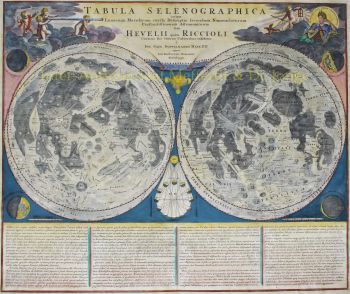
Moon - Homann, Doppelmayr, Hevelius by Johann Baptist Homann
Scroll to zoom, click for slideshow

Moon - Homann, Doppelmayr, Hevelius 1742 - 1748

Johann Baptist Homann

Papier
48 ⨯ 58 cm
€ 1.950

Inter-Antiquariaat Mefferdt & De Jonge

  • Über Kunstwerk
    IMPORTANT MAP OF THE MOON “Tabula Selenographica in qua Lunarium Macularum exacta Descriptio secundum Nomenclaturam … Hevelii quam Riccioli”. Copper engraving made by Johann Baptist Homann after Johann Gabriel Doppelmayr, from the Atlas Coelestis in quo Mundus Spectabilis published in Nuremberg in 1742 or 1748. Coloured by a later hand. Size c. 48,5 x 58 cm. The left hand lunar map, composed by Johannes Hevelius, is a considered a foundational map in the science of Selenography – or lunar cartography. This map first appeared in Hevelius’ 1647 work Selenographia which laid the groundwork for most subsequent lunar cartographic studies. Here the moon is presented as it can never be seen from Earth, at a greater than 360 degrees and with all visible features given equal weight. In this map Hevelius also establishes the convention of mapping the lunar surface as if illuminated from a single source – in this case morning light. The naming conventions he set forth, which associate lunar features with terrestrial locations such as “Asia Minor”, “Persia”, “Sicilia”, etc. were popular until the middle of the 18th century when Giovanni Battista Riccioli’s nomenclature took precedence. The Riccioli map, on the right, is more properly known as the Riccioli-Grimaldi map, after fellow Jesuit Francesco Grimaldi with whom Riccioli composed the chart. This map first appeared in Riccioli and Grimaldi’s 1651 Almagestum Novum. This was a significant lunar chart and offered an entirely new nomenclature which, for the most part, is still in use today. Curiously, though Riccioli, as a devout Jesuit, composed several treatises denouncing Copernican theory, he chose to name one of the Moon’s most notable features after the astronomer – perhaps suggesting that he was a secret Copernicus sympathizer? Other well-known lunar features named by Riccioli include the Sea of Tranquility where Apollo 11 landed and where Neil Armstrong became the first human to set foot on the moon’s surface 50 years ago. The upper left and right hand quadrants feature decorative allegorical cartouche work that include images of putti looking through a telescope and a representation of the ancient Greek Moon goddess Selene. Additional smaller maps show the moon in various phases of its monthly cycle. Below the map proper extensive Latin text discusses Selenography. This map first appeared Johann Baptist Homann’s 1707 Neuer Atlas and was later reissued as plate no. 11 in Doppelmayr’s important 1742 Atlas Coelestis, which was also published by Homann. Price: Euro 1.950,-
  • Über Künstler

    Johann Baptist Homann (1664–1724) war ein bedeutender deutscher Kartograf, Kupferstecher und Verleger des frühen 18. Jahrhunderts und gilt weithin als einer der einflussreichsten Kartenmacher seiner Zeit. Geboren in Oberkammlach in Bayern, besuchte er zunächst eine Jesuitenschule, bevor er zum Protestantismus konvertierte – eine Entscheidung, die seinen persönlichen und beruflichen Werdegang prägen sollte.Johann Baptist Homann (1664–1724) war ein bedeutender deutscher Kartograf, Kupferstecher und Verleger des frühen 18. Jahrhunderts und gilt weithin als einer der einflussreichsten Kartenmacher seiner Zeit. Geboren in Oberkammlach in Bayern, besuchte er zunächst eine Jesuitenschule, bevor er zum Protestantismus konvertierte – eine Entscheidung, die seinen persönlichen und beruflichen Werdegang prägen sollte.

    Homann begann seine Laufbahn 1687 als Notar in Nürnberg, wandte sich aber bald der Kupferstecherei und Kartografie zu, angetrieben von seinem wachsenden Interesse an Geografie und der visuellen Darstellung von Wissen. Nach einer prägenden Zeit in Wien zwischen 1693 und 1695 kehrte er nach Nürnberg zurück, wo er 1702 seinen eigenen Verlag gründete. Dies markierte den Beginn einer äußerst produktiven und einflussreichen Karriere.

    Seine Karten erlangten schnell Anerkennung für ihre Präzision, Klarheit und ihren dekorativen Reichtum, der wissenschaftliche Strenge mit aufwendiger barocker Ornamentik verband. Homanns Ruf führte 1715 zu seiner Ernennung zum kaiserlichen Geographen durch Kaiser Karl VI., und später wurde er in die Preußische Akademie der Wissenschaften in Berlin gewählt – eine Anerkennung seines Beitrags zur Förderung der Geographie.
    1716 veröffentlichte Homann sein berühmtestes Werk, den „Großen Atlas über die ganze Welt“, eine umfassende und ambitionierte Kartensammlung, die sein Vermächtnis festigte. Viele dieser Werke entstanden in Zusammenarbeit mit dem Kupferstecher Christoph Weigel dem Älteren. Mit seinem Verlag und seinen kartographischen Arbeiten trug Homann maßgeblich dazu bei, Nürnberg zu einem bedeutenden Zentrum der Kartenproduktion in Europa zu entwickeln.

Sind Sie daran interessiert, dieses Kunstwerk zu kaufen?

Artwork details